He Didn't Know We Were Watching: The Turkish Broadcaster Who Went Viral in America Without a Single Word of English
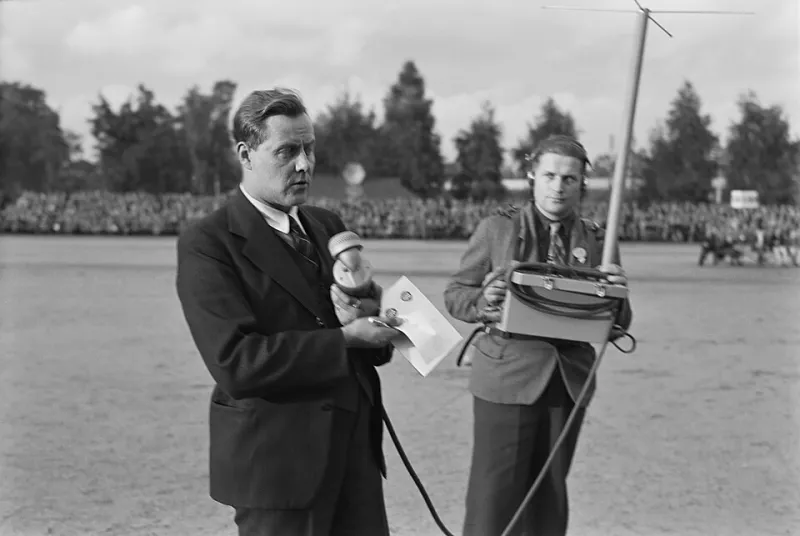
Photo: Archives of the Finnish Broadcasting Company Yle, Public domain, via Wikimedia Commons
The Call Heard Round the World (Literally)
There's a clip making the rounds on American soccer Twitter. Ninety seconds long. A Kastamonu striker equalizes in the 89th minute, and a voice on the radio feed detonates — a rising, cracking, unhinged roar that sounds less like broadcasting and more like a man being personally liberated. The captions read: "HE'S DONE IT. THE CITY IS SHAKING. I HAVE STOPPED BEING A BROADCASTER. I AM A CITIZEN."
The clip has 2.3 million views. The commenter, Hakan Demirtaş, didn't know any of this existed until three weeks ago.
"A nephew showed me his phone," Hakan tells me in the cramped studio above the club shop, gesturing at a mixing board older than some of his listeners. "He said, 'Amca, you are famous in America.' I said, 'In America? What did I sell them?'"
He didn't sell them anything. That's kind of the point.
How a Turkish Radio Feed Ends Up in a Group Chat in Ohio
The pipeline is pure internet folk art. Fans record Hakan's radio calls off the club's low-budget stream, clip the emotional peaks, and subtitle them — sometimes with rough machine translation, sometimes with what Hakan calls "creative English." One fan runs a dedicated account that translates his best calls within hours of full-time.
If you've ever watched a Premier League match with an American broadcast and felt something was missing, this is the missing thing. Hakan doesn't do measured analysis. He does weather. He does geology. When Kastamonu conceded a stoppage-time winner last spring, his call reportedly included a full ten seconds of silence, then: "I will now describe the grief of an entire province."
American fans, raised on a diet of neutral play-by-play, found it and lost their minds. One Reddit thread titled "This Turkish commentator is what soccer coverage should be" hit the front page of a soccer subreddit. Someone in the comments wrote: "I don't speak Turkish. I have never been to Turkey. I would die for this man."
The Moment He Found Out
Hakan, 54, has called Kastamonu matches for eleven seasons. Before that, he did livestock market reports on the same station. He has never missed a home fixture. He prepares by handwriting his notes — no laptop, no stats software, just a notebook with players' names underlined twice for emphasis.
So when the nephew showed him the TikToks, his first reaction wasn't delight. It was professional panic.
"I asked if my grammar was bad in the translation," he says, laughing. "He told me the translations are terrible. I told him good, then nobody knows what I actually said."
But the more he watched, the more something shifted. Here were strangers in a country he'd never visited, reacting to his voice like it was their own. A fan in Texas had gotten "I AM A CITIZEN" tattooed — in English, under a Kastamonu badge. Hakan asked for a photo of the tattoo. He keeps it on his phone now.
"Passion has no dictionary," he says. "You scream, they understand. That is the whole language."
The Bilingual Call
Which brings us to last Saturday. Kastamonu hosted a mid-table side in front of a sold-out stand, and Hakan did something he'd never done: he delivered a goal call in two languages.
He'd practiced for weeks. A fan-run account had sent him phonetic guides; his nephew drilled him on pronunciation over dinner. When Kastamonu scored in the 34th minute, Hakan let loose his usual Turkish eruption, paused, and then — in careful, deliberate, deeply endearing English — said: "AND THAT... IS FOR OHIO."
The stand didn't know what he meant. The internet did. The clip crossed 4 million views by Monday morning.
"My English is bad," he admits. "But the fans there have bad Turkish. So we are even."
What This Says About the New Global Fan
There's a real lesson here for anyone who thinks small clubs need English-language broadcasts or a streaming deal to find an audience. The barrier between a regional radio man in Anatolia and a college kid in Michigan is now just a phone recording and a stranger willing to type subtitles.
Fan-made translation has quietly become the most effective international marketing tool in sports — organic, unpaid, and more trusted than anything a club could produce. American fans aren't discovering Kastamonu despite the language barrier. They're discovering it through the barrier, the way you might love a song in a language you don't speak.
Hakan finds the whole thing slightly absurd, and says so. But he's also started ending his calls with one English word, learned for the occasion: "Family."
"They are far," he says, packing up his notebook. "But radio is patient. It waits for people."
Somewhere in Ohio, someone is already subtitling this interview.